Stainless Steel Investment Casting
What is investment casting?
Investment casting, also known as the lost-wax process, is a near-net-shape casting method capable of producing parts with fine surface finish, intricate geometry and tight dimensional tolerances. A wax pattern of the part is built, assembled into a tree, and repeatedly dipped into a ceramic slurry to form a shell. The wax is melted out, the shell is fired, and molten stainless steel is poured into the cavity. Once cooled, the shell is broken away and the casting is cut from the runner system, ground, heat-treated and inspected.
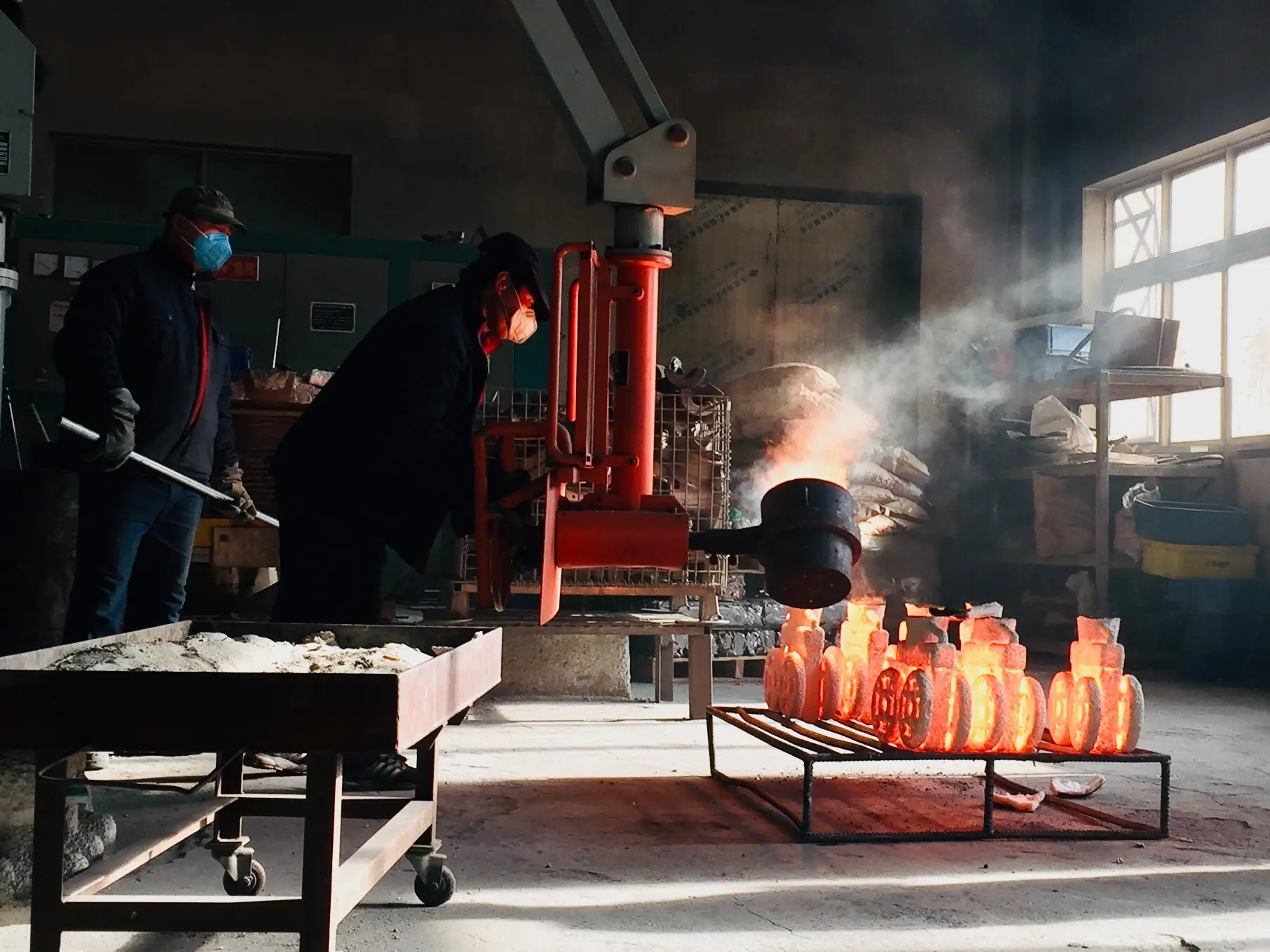
We use the silica sol process (also referred to as silica colloidal investment casting), which produces a smoother surface finish and tighter tolerances than the water-glass process. This makes it especially well suited to stainless steel parts that will see machining, polishing or close-fit assembly, and reduces the amount of secondary stock and rework required downstream.
In-house process capability
Our partner foundry runs a fully integrated investment casting operation, with the following stages performed under one roof:
- Toolmaking and wax-injection die manufacture
- Wax-model making and tree assembly
- Silica sol shell building and de-waxing
- Melting and pouring of stainless, carbon and alloy steels
- Heat treatment, shot blasting and surface finishing
- CNC machining, turning, milling and grinding
- Wax recovery and process recycling
Vertical integration matters because it shortens lead times, keeps tolerances under one quality system, and avoids the hand-offs that often introduce defects in multi-supplier supply chains. It also lets us cost-engineer parts properly: in many cases we can redesign a fabricated or machined-from-bar component as a single casting and remove significant material and machining cost.
Stainless steel grades we cast
Our partner foundry holds a TÜV Rheinland certificate under PED 2014/68/EU Annex I §4.3 (Notified Body 0035). Its stainless scope covers valve parts from 0.1 to 60 kg, 2 to 100 mm wall thickness and Ø 3 to 800 mm, in these grades:
- To BS EN 10213, solution annealed: 1.4308 and 1.4309, the cast equivalents of 304 and 304L; 1.4408 and 1.4409, the cast equivalents of 316 and 316L; and 1.4469 cast super duplex
- To ASTM A351, solution annealed: CF8, CF3, CF8M and CF3M. A particular material appraisal (PMA) is required where these are used in pressure equipment under the directive
Beyond the certified scope, the foundry also casts:
- Duplex: 1.4470 / CD3MN, cast duplex 2205
- Nickel alloy C276, cast to ASTM A494. Nickel castings are outside BS EN 10213, so the ASTM designation is the governing one here
These sit outside the PED certificate, so they cannot be used to claim conformity under the directive, but they are supplied with full chemical and mechanical certification in the usual way.
Other grades and bespoke chemistries can be matched against your specification or drawing. Material is verified by spectrometer at the foundry and again on receipt where required, and full chemical and mechanical certification is supplied with every batch.
Sizes, tolerances and finish
| Single-piece weight | Typically 10 g to 25 kg; up to approximately 50 kg per casting |
| Linear tolerance | Typically CT4–CT6 (ISO 8062) on as-cast features |
| Surface finish | Ra 3.2 µm or better on most as-cast surfaces |
| Wall thickness | Down to 2 mm on suitable geometries |
| Machined features | Held to drawing tolerance via in-house CNC and grinding |
Quality, testing and certification
Stainless steel investment castings used in pressure equipment cannot be signed off on appearance alone. Every part we ship is supported by a documented quality plan and a level of testing matched to the application. Standard capabilities include:
- ISO 9001:2015 quality management system
- PED 2014/68/EU compliance for pressure-bearing castings. PED explained →
- TÜV Rheinland (Notified Body ID-No. 0035) approval for precision steel castings up to 60 kg under Directive 2014/68/EU Annex I §4.3 and AD 2000-Merkblatt W0, certificate no. 01 202 CHN/Q-16 0588
- Chemical analysis by optical emission spectrometer
- Mechanical testing: tensile, hardness, impact (Charpy down to -196 °C)
- Dimensional inspection on coordinate-measuring machine (CMM)
- Non-destructive testing: dye penetrant (PT), magnetic particle (MT), radiographic (RT) and ultrasonic (UT) on request
- End-of-line hydrostatic and pneumatic pressure testing
- Full material and inspection certification (3.1 / 3.2 EN 10204) supplied with every shipment. EN 10204 3.1 vs 3.2 explained →
Industries and applications
Our stainless steel investment castings are specified into demanding sectors where failure is not an option:
- Valves & flow control: ball valve bodies and caps, butterfly discs, gate/globe/check bodies, seats, stems, actuator brackets, trim
- Pumps: impellers, diffusers, volutes, wear rings, seal housings, chemical process pumps (ISO 2858 / ANSI B73)
- Food, dairy & beverage: hygienic pump parts, tri-clamp fittings, mixer and agitator blades, meat processing equipment, brewing fittings, conveyor components
- Pharmaceutical & biotech: sanitary and diaphragm valve bodies, sterile fittings, agitator hubs
- Chemical & petrochemical: duplex and super duplex fittings, spray nozzles, manifolds, corrosion-resistant hardware
- Oil & gas / subsea: choke bodies, wellhead components, clamp connectors, downhole tool bodies
- Cryogenic service: LNG, industrial gases and low-temperature instrumentation
- Marine & rigging: deck hardware, cleats, chocks, fairleads, hatch dogs, winch parts, rudder fittings, sea water pump components, rigging terminals
- Medical & surgical: instrument jaws and handles, orthopaedic components (CoCr), dental, sterilisation trays, bed and trolley hardware
- Architectural & structural glazing: spider fittings, cable tensioners and fork terminals, balustrade brackets, façade anchors
- Rail: brake linkages, coupler parts, pantograph components, signalling housings
- Automotive & motorsport: exhaust manifolds and turbine housings (SiMo / 1.4849), flanges, rocker arms, lock and latch components
- Power generation: steam turbine blades, industrial gas turbine vanes, boiler and feedwater components
- Water treatment: pump internals, sluice and penstock components, dosing equipment
- General engineering: quick-release couplings, robot end-effectors, hinges, latches, levers, brackets, equestrian and climbing hardware
If you produce equipment in any of these sectors and you are sourcing stainless castings from multiple suppliers, there is usually a strong case for consolidating with a single, certified partner.
Get a QuoteRelated processes and guides
Aluminium Castings
Gravity die castings in aluminium alloy for pressure-bearing and structural applications, PED 2014/68/EU certified.
Aluminium castings →Ductile Iron Castings
Resin sand (no-bake) casting for heavier parts, from a few kilograms to around one tonne, pattern through to machined component.
Resin sand ductile iron →CNC Machining
Finish machining of castings to drawing, with CMM inspection before shipment. Castings and machining under one purchase order.
CNC machining →Casting RFQ Guide
What to specify in an enquiry, from drawings and material grade to certification and delivery terms, so a quotation comes back right first time.
What to include in a casting RFQ →