What to Include in a Casting RFQ
Every week we receive enquiries for castings that we cannot quote without a round of clarification questions. A request for quotation that arrives complete gets priced faster, more accurately, and with fewer assumptions that later turn into surprises. This article lists the seven things a casting RFQ should specify, and explains what happens to your enquiry when any of them is missing.
1. Drawings and 3D models
The single most important item. Send a 2D drawing (PDF) carrying the tolerances, material specification and revision level, together with a 3D model in STEP format. The 2D drawing is the contractual document: it defines what "good" means at inspection. The 3D model is what the foundry uses to design tooling and simulate the casting process.
If only one exists, send it anyway and say so. A quotation can be prepared from a 3D model alone, but critical tolerances and surface requirements will be assumed, and those assumptions will be listed in the quote.
2. Material grade and standard
"Stainless steel" is not a specification. There are dozens of cast grades with different corrosion resistance, strength and price. Always give the grade together with the standard it should be supplied to, for example:
- 1.4408 to EN 10213, or its ASTM near-equivalent CF8M to ASTM A351
- AC-42000 (LM25) to EN 1706 for aluminium gravity die castings
- AC-46000 to EN 1706 for high pressure die castings
If you only know the wrought equivalent (for example 316 bar stock), say that, and the cast equivalent can be confirmed for you. If the application is pressure-bearing or cryogenic, state it here: it affects grade selection, testing and certification.
3. Quantities and batch sizes
Casting prices depend heavily on volume. Tooling is quoted as a separate, one-off cost, and the unit price then depends on how many parts are produced and in what batches. Give both the estimated annual usage and the typical call-off batch size. "5,000 per year in batches of 500" is a different quotation from "5,000 as a single delivery", and both are different from a one-off prototype run.
If this is a new project, an honest range is more useful than a guess presented as a commitment.
4. Tolerances and critical dimensions
General casting tolerances are defined by ISO 8062 tolerance grades (typically CT4–CT6 for investment casting). Anything tighter than the general tolerance must be machined, so identify the critical features explicitly on the drawing. A drawing that tolerances every dimension tightly "to be safe" will be quoted with machining on every surface, usually far more expensive than necessary.
5. Certification and testing requirements
State the documentation the parts must ship with. The common requirements are:
- EN 10204 3.1 certificate: chemical and mechanical results traceable to the casting batch; the standard requirement for most industrial work
- EN 10204 3.2 certificate: witnessed by an independent third party; typical for higher PED categories
- NDT: dye penetrant, radiographic or ultrasonic examination where soundness must be demonstrated
- Pressure testing: hydrostatic or pneumatic, with test certificate
Certification requirements affect which foundry can produce the part and must be known at quotation, not discovered at delivery. If the part falls under PED 2014/68/EU, say so in the RFQ; see our guide PED 2014/68/EU explained.
6. Surface finish and post-processing
List everything that happens to the part after casting: CNC machining (send the machining drawing if separate), surface finish requirements in Ra, passivation, anodising (type and class; see our anodising guide), painting, plating or polishing. Post-processing is often quoted through different suppliers, so an incomplete finishing specification is a common cause of quotation delay.
7. Delivery terms and timing
State the delivery address and any date the parts are needed by. We quote DDP (Delivered Duty Paid) to your works as standard: freight, customs clearance and import duty are included, so the price on the quotation is the landed cost. If you need different Incoterms, say so in the RFQ. And if there is a hard deadline, such as a production line start or a project milestone, say so up front: it determines whether standard lead times work or whether options like expedited tooling need to be considered.
What happens when the RFQ is complete
With all seven items in hand, a casting enquiry can be assessed in a single pass: material and certification scope confirmed against foundry approvals, tooling and unit price calculated against real volumes, and post-processing quoted alongside the casting rather than as an afterthought. The result is a quotation you can compare fairly against others, because it prices what you actually need, not what the supplier assumed.
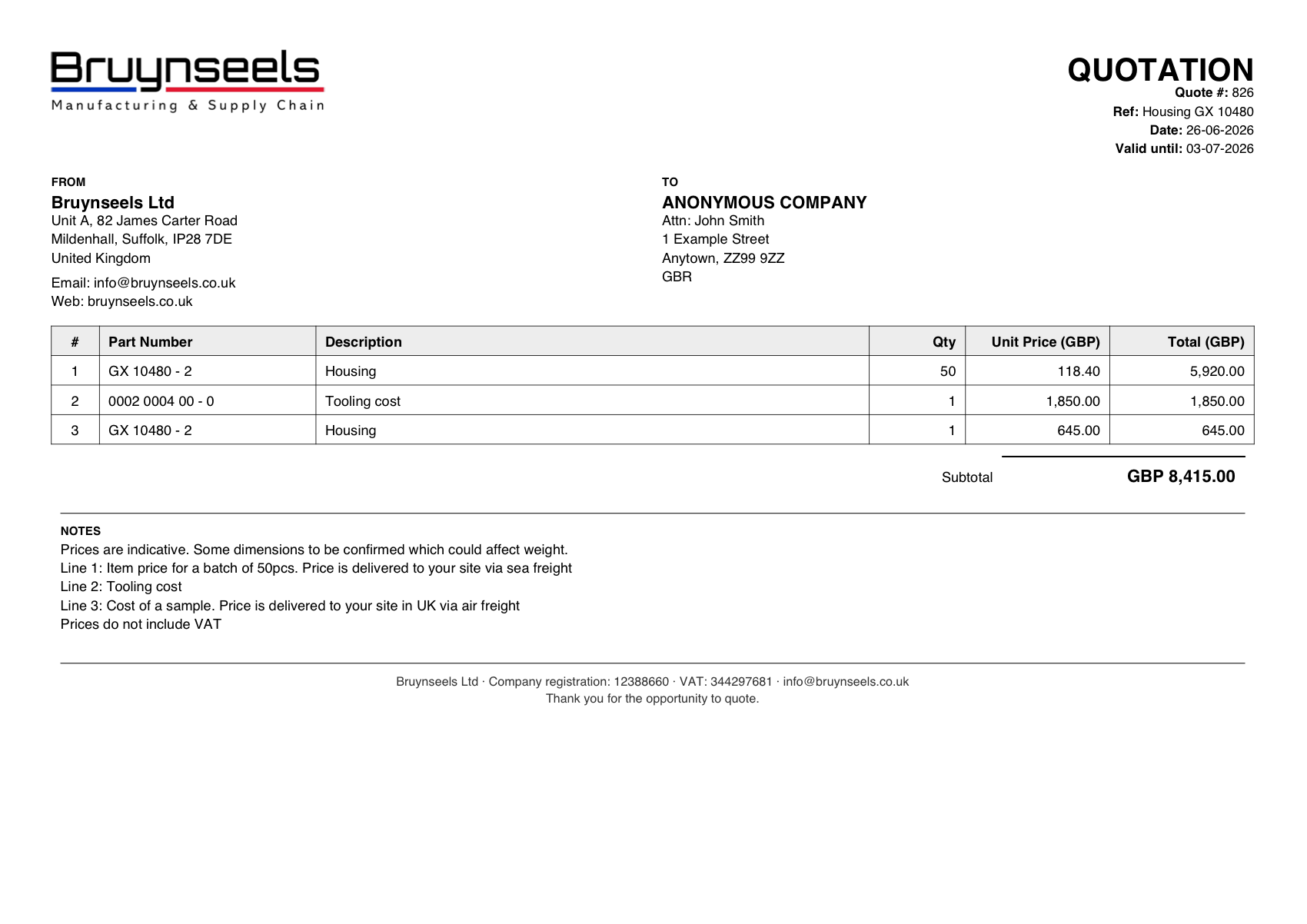
Have a casting or machined part to quote? Send us your drawing and specification and we will return a budgetary quotation within three working days.
Get a Quote More Articles