Anodising of Aluminium
What is anodising?
Anodising is an electrochemical process that converts the surface of aluminium into a hard, porous aluminium oxide layer. Unlike a paint or plating that sits on top of the metal, the anodic coating is integral to the aluminium — it grows both outward from and inward into the base material. The result is a surface that is harder than untreated aluminium, highly corrosion resistant, electrically non-conductive and, where required, receptive to dyeing.
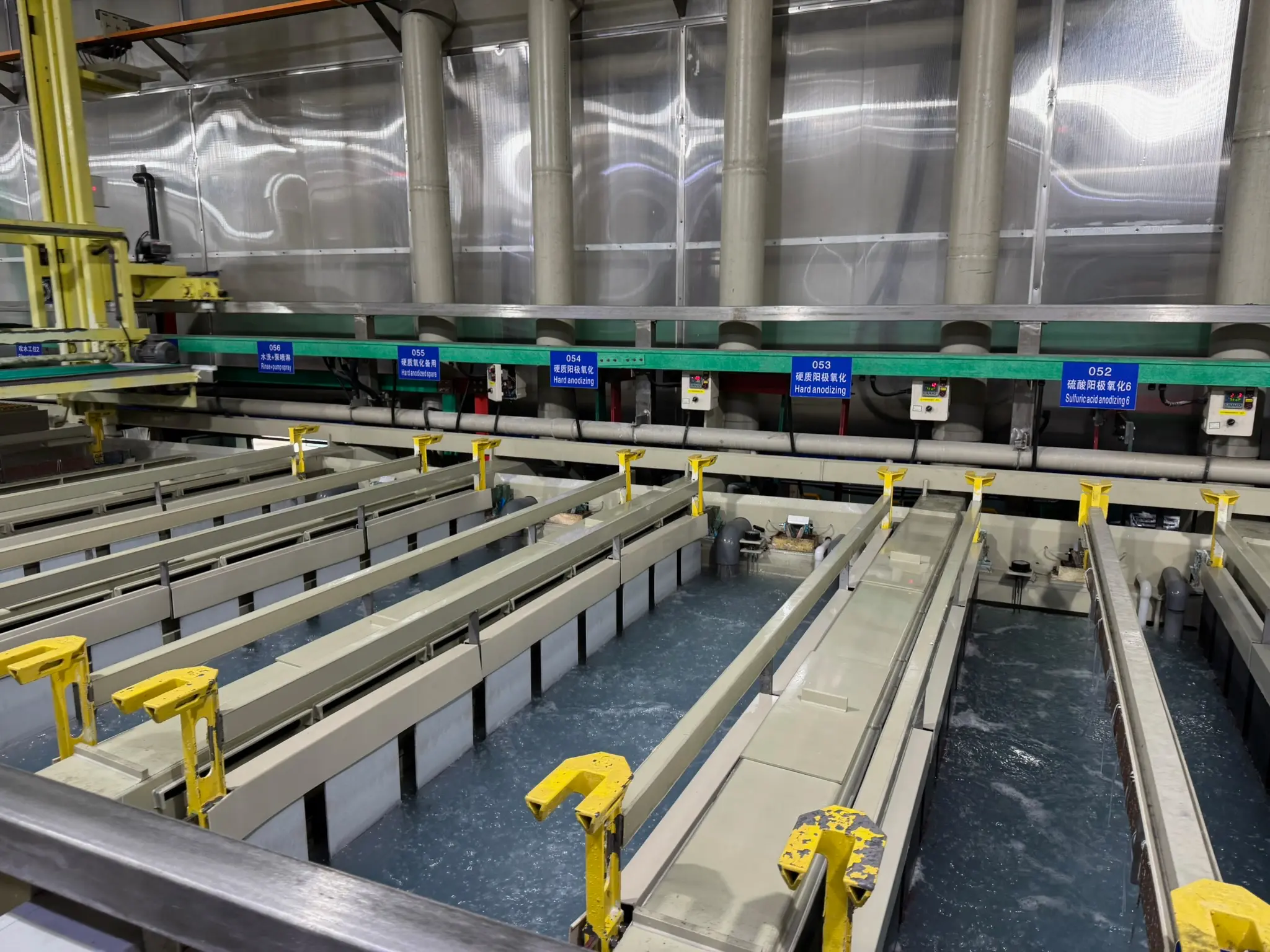
Anodising is governed by MIL-A-8625F — the US Department of Defense specification for anodic coatings on aluminium and aluminium alloys, which is universally recognised as the industry-standard reference regardless of end-market. It defines six coating types and two finish classes.
Anodising types — MIL-A-8625F
MIL-A-8625F specifies six types of anodic coating, each produced by a different electrolyte and process chemistry:
| Type I | Chromic acid anodising. Produces the thinnest coating (typically 0.5–2.5 µm). Minimal dimensional change. Good corrosion protection. Used on fatigue-sensitive aerospace structures where coating thickness must be minimised. Chromic acid is subject to environmental restrictions in many jurisdictions. |
| Type IB | Chromic acid anodising (low voltage variant). Processed at 22 ± 2 V instead of the conventional ramp to 40 V. Slightly thinner coating than Type I; useful for complex shapes where the standard process can cause burning at sharp edges or in blind holes. |
| Type IC | Non-chromate alternative to Types I and IB. Produces equivalent corrosion protection without chromic acid, using alternative proprietary electrolytes. Increasingly specified to meet REACH and RoHS requirements where Types I/IB would otherwise apply. |
| Type II | Sulphuric acid anodising. The most widely used process. Coating thickness 1.8–25 µm (typically 5–18 µm in practice). Good corrosion resistance, good adhesion for subsequent painting or bonding. The standard choice for general industrial, marine and decorative applications. |
| Type IIB | Thin sulphuric acid anodising. Non-chromate alternative to Types I/IB, using sulphuric acid at reduced thickness (0.5–7.6 µm). Provides similar corrosion performance to Type I without chromic acid, at lower cost than Type IC proprietary chemistries. |
| Type III | Hard anodising (hardcoat). Produced in sulphuric acid at low temperature and high current density. Coating thickness 12.5–114 µm. Produces an extremely hard, dense oxide layer (Vickers hardness 400–600 HV depending on alloy). Used where wear resistance, abrasion resistance or electrical insulation are required. Typically supplied unsealed to preserve maximum hardness. |
Classes
Each type is available in two classes:
| Class 1 | Non-dyed (undyed). Natural anodic oxide colour — typically silver-grey to dark grey depending on alloy. Used where appearance is not critical or where subsequent painting or bonding is intended. |
| Class 2 | Dyed. Organic dyes are absorbed into the porous oxide before sealing, producing uniform colour. Black, gold, red, blue and other colours available. Dye uptake and consistency depend on alloy and coating thickness; casting alloys with high silicon content produce less uniform colour than wrought alloys. |
Coating thickness and dimensional growth
MIL-A-8625F Table IV specifies the following coating thickness ranges:
| Types I, IB, IC, IIB | 0.5–18 µm (0.00002–0.0007 inch) |
| Type II | 1.8–25 µm (0.00007–0.0010 inch) |
| Type III | 12.5–114 µm (0.0005–0.0045 inch) |
Dimensional growth. Because the anodic oxide grows both outward and inward, the external dimension of a part increases by approximately half the total coating thickness per surface. For a Type II coating at 18 µm, a bore diameter decreases by approximately 18 µm (9 µm per wall). For Type III at 50 µm, dimensional change is significant — typically 25 µm per surface — and must be accounted for at the machining stage. We recommend discussing anodising intent before finalising tight-tolerance features so machined dimensions can be appropriately pre-compensated.
Alloy suitability and casting considerations
MIL-A-8625F places compositional limits on anodisable alloys. These are particularly relevant for aluminium casting alloys, which often contain elevated silicon:
- Types I, IB, IC: copper content must not exceed 5%; silicon content must not exceed 7%
- Type III: copper content must not exceed 5%; silicon content must not exceed 8%
- Type II and IIB are not restricted by the same compositional limits in the specification and can be applied to higher-silicon alloys
Common casting alloys and their suitability:
| LM25 / A356 (AlSi7Mg) | Si ≈ 6.5–7.5%. Suitable for Types I–III subject to Si limit; Type II and III routinely applied. Good hardcoat results with appropriate process control. |
| LM6 (AlSi12) | Si ≈ 10.5–13.5%. Exceeds the 7–8% Si limits for Types I, IB, IC and III. Type II and IIB can be applied. Hardcoat (Type III) is generally not recommended. Colour uniformity for Class 2 dyed finishes is limited. |
| LM9 (AlSi10Mg) | Si ≈ 9–11%. Similar considerations to LM6 — Types II and IIB are the practical options. Dye uptake is variable. |
| LM4 (AlSi5Cu3) | Si ≈ 4–6%, Cu ≈ 2.5–3.5%. Cu content approaches the 5% limit. Type II can be applied but hardcoat quality is reduced by copper content. Consult before specifying Type III. |
Where anodising is a firm requirement, alloy selection should be made with the coating in mind. LM25 / A356 offers the best combination of casting integrity and anodising compatibility among the gravity die alloys.
Sealing
After anodising, the porous oxide structure must be sealed to close the pores and achieve full corrosion protection. MIL-A-8625F requires sealing for Types I through IIB. Sealing options include:
- Hot deionised water seal — immersion in near-boiling DI water (≥96 °C). Simple and widely used. Produces a hydrated aluminium oxide plug in each pore.
- Dichromate seal — sodium or potassium dichromate solution. Enhances corrosion protection through chromate incorporation. Subject to environmental restrictions in EU/UK.
- Nickel or cobalt acetate seal — the principal alternative to dichromate seal; good corrosion resistance without hexavalent chromium. Widely used for aerospace and defence applications.
Type III (hardcoat) is typically supplied unsealed. Sealing fills the pores and reduces the hardness and wear resistance of the coating. Where lubrication or PTFE impregnation is required, these can be specified instead of a conventional seal.
Corrosion testing
Anodised coatings to MIL-A-8625F are tested for corrosion resistance by neutral salt spray in accordance with ASTM B117. The minimum requirement under MIL-A-8625F is 336 hours without corrosion of the base metal. Test panels processed with the production run are typically retained as objective evidence.
Typical applications
- Type II, Class 1 — general corrosion protection on housings, brackets, covers and structural components; pre-treatment before painting or powder coating
- Type II, Class 2 — decorative components, instrument panels, consumer and industrial products requiring colour coding
- Type III, Class 1 — wear surfaces, valve components, hydraulic actuator bodies, guide rails, sliding interfaces; electrical insulation (Type III coatings are highly resistive)
- Type I / IB — fatigue-sensitive aerospace structures where minimum coating thickness is required; rework of close-tolerance parts
What we can supply
We work with a specialist surface treatment facility with an experienced technical team and dedicated process lines for aluminium anodising. The following processes are available:
- Type II sulphuric acid anodising — standard corrosion protection, Class 1 (natural) or Class 2 (dyed)
- Type III hard anodising — wear and abrasion resistant hardcoat, Class 1
- Coloured / dyed anodising — Class 2 finishes in a range of colours on Type II coatings
The same facility also provides complementary surface treatments for other materials we supply:
- Stainless steel electropolishing — electrochemical polishing to improve surface finish, corrosion resistance and cleanliness on stainless steel castings and machined parts
- Copper acid washing and passivation — cleaning and passivation of copper alloy components
- Titanium alloy surface treatment — specialist treatment of titanium components
Anodising as part of our supply chain
We coordinate anodising as part of an integrated supply package — casting, machining and surface treatment managed under a single order. Parts are delivered to the anodising shop already inspected and dimensionally verified. We specify and review the process parameters (type, class, thickness range) on the production order, and return documentation confirms coating thickness (typically measured by eddy-current probe per ASTM B244) and salt spray compliance where required.
For toleranced features affected by coating growth — bores, spigots, threaded holes — we will advise on pre-anodise machining allowances at the design stage.
If you have an aluminium component that requires anodising, contact us with your drawing and coating specification. We will advise on alloy suitability, dimensional allowances and the appropriate MIL-A-8625F type for your application.
Get a Quote